|
Magnetic Therapy Supplies |
|
Proudly Manufactured, Imported and Distributed |
|
by Mid- American Marketing Corp. |
|
800.922.1744 |
What About Gauss? What is gauss? The Permanent Magnet Design and Application Handbook by Lester Moskowitz provides the following definition: gauss: The cgs unit of magnetic induction. For clarification let us proceed to the definition of magnetic induction. Induction, magnetic (general): The flux per unit area measured at right angles to the direction of the flux. If after reading the above definitions you feel that you don’t know much more than you did before reading them, you are not alone. For our purposes it is probably best to approach this question from a different direction and establish what gauss is not. Gauss is not a number which indicates the strength of a magnet. Unfortunately there isn’t a number which describes the overall strength of a magnet in an open circuit. Magnets used for biomagnetic purposes are described as open-circuit magnets because they do not have supplemental ferromagnetic parts to provide a complete path for the magnetic energy. Any type of "bare" magnet falls into this category. This would include magnets used in mattresses, support items, jewelry, and encased blocks. When people see magnetic products described in terms of gauss they incorrectly assume that these magnets have been measured in some way and that this "gauss rating" describes the strength of the magnet the same way that a gasoline engine could be described in terms of horsepower or cubic inches. A gauss meter is an instrument which can be used to measure lines of magnetic flux at a specific point on a magnet but that reading provides no information about the total energy of the magnet being tested or about how far the energy will project from its surface. In describing their products some people talk about a manufacturer’s rating. This manufacturer’s rating refers to a specific property of a magnet which will be the same for any size magnet made from the same material. (See Figs. 2 & 3.) Once again it is not a measure of the total energy of a magnet.
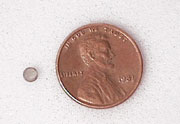
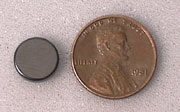
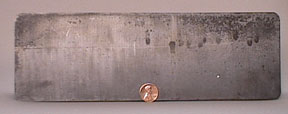
The photographs above illustrate the problems both with using the manufacturer’s rating and with taking a measurement with a gauss meter. Fig. 1 shows a neodymium-iron-boron magnet. The manufacturer’s rating for this magnet is 12,500 gauss. The flux density on the surface of this magnet, measured using a gauss meter is 985 gauss. A simple magnetometer, a device used to measure field strengths, reads 2 gauss at a distance of 1/8" from the surface of the magnet. Fig. 2 shows a ferrite ceramic magnet. The manufacturer’s rating for this magnet is 3850 gauss. The flux density on the surface of the magnet, measured using a gauss meter, is 565 gauss. The magnetometer reads 2 gauss at a distance of approximately 3/4" from the surface of the magnet. Fig. 3 shows a ferrite ceramic magnet measuring 10 5/8" X 3 1/2" X 1". The manufacturer’s rating for this magnet is 3850 gauss. The flux density on the large flat surface of the magnet measures 980 gauss at the end, 720 gauss at the sides and 465 gauss at the center. The magnetometer measures 2 gauss at a distance of approximately 20" from the surface of the magnet. The total strength of a magnet depends both on the type of magnetic material and the size. From the illustrations above it should be obvious that the "gauss" readings don’t really provide any useful information. Although it has the highest numbers, the magnet in Fig. 1 is so small that the total energy is quite low and practically imperceptible at only a slight distance from its surface. The people who quote "gauss" when talking about their biomagnetic products seem to fall into two categories: Category 1. These people simply do not know what the numbers they use mean and just repeat what their suppliers have told them. They may actually believe that these numbers are meaningful and describe the strength of a magnet. Category 2. These people may or may not know that for all intents and purposes these numbers are meaningless but they deliberately use them in an attempt to make their products look better. Most people seem to think that if a little is good, more is better; bigger is better; stronger is better. Playing on human nature, the unscrupulous marketer simply makes sure that his numbers are higher. If company A (in category 1) has a product which it describes as 800 gauss then company B (the unscrupulous marketer) simply describes his version of the same product as 1000 gauss or whatever number sounds good. Regardless of the reason for doing so, people who market their products on the basis of gauss are deceiving their customers. The customer is led to believe that he is being provided information about the product which he can use as a basis for comparison and for making an informed decision which in fact is not the case. If someone offers products and describes them with "gauss" you should ask two questions. 1. What does gauss mean? 2. How did you arrive at the "gauss" reading? If he answers that gauss is the strength of the magnet and that the numbers were obtained using a gauss meter or that they are manufacturer’s ratings, then you are dealing with someone in one of the two categories above. In either case you are not likely to get any accurate information about the products you are buying. It seems that most people in "biomagnetics" have taken the easy path: pick a number that sounds good and put it on your product; the customer will never know the difference. The path may not be easy but we feel it is better to provide our customers with as much truthful and helpful information as we can so that they make their decisions based on fact rather than on some fiction invented to try to make a sale. Quality products speak for themselves and do not have to be sold on the basis of misinformation. | |||
|
|
|
Copyright 2001-2010 Mid-American Marketing Corp.